A old typewriter font tattoo font can make a name, date, or quote feel like a line taken from an old letter. The style is simple, literary, and instantly recognizable but a font that looks clean on a screen still needs to be adapted before it becomes a tattoo.
The most successful typewriter tattoos use clear letterforms, enough space between details, and a size suited to the chosen placement. This guide compares seven useful styles and explains what to discuss with your tattoo artist before approving the stencil.
Important: This article offers design guidance, not medical advice. Tattoo longevity depends on the design, the artist’s technique, placement, skin, healing, sun exposure, and long-term care. Follow the aftercare instructions provided by your tattoo artist or healthcare professional.
In this article, I’ll guide you through everything you need to know about selecting, customizing, and applying a typewriter font for tattoo so your design not only looks great but also lasts beautifully over time.

Quick Comparison of Typewriter Tattoo Fonts
The fonts below are starting points, not ready-made stencils. A tattoo artist may redraw the letters, strengthen thin areas, open tight counters, or adjust spacing to suit the body.
| Font | Visual Character | Best Starting Point For | What to Watch |
|---|---|---|---|
| Courier Prime | Clean, balanced, familiar | Quotes, dates, names | Regular weight may still need strengthening at small sizes |
| Special Elite | Distressed, uneven, vintage | Literary words and intentionally imperfect designs | Fine distressed texture can disappear or become muddy |
| Cutive Mono | Light, open, understated | Airy one- or two-line phrases | Thin strokes require careful size and weight decisions |
| Prestige Elite | Compact, mid-century, mechanical | Dates, initials, short statements | Some digital versions are narrow or heavily distressed |
| American Typewriter | Warm slab serif, less rigid | Names and expressive quotes | It is not fully monospaced and may feel less mechanical |
| IBM Plex Mono | Modern, engineered, highly structured | Minimalist or technical-looking text | It feels contemporary rather than antique |
| Courier New | Familiar, neutral, widely available | Early mockups and simple references | Default regular weight can look too light on skin |
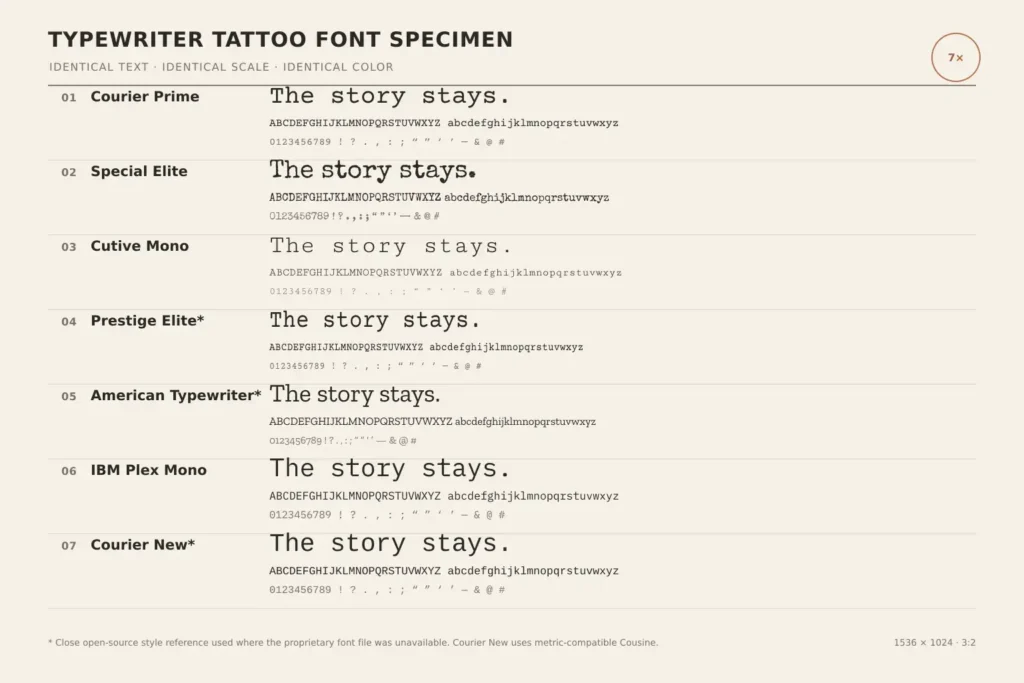
1. Courier Prime: The Clean Classic
Courier Prime is a refined interpretation of Courier created for screenplays. Its familiar slab serifs and consistent character widths produce the recognizable typewritten rhythm without relying on heavy distressing.
It is a strong starting point for dates, coordinates, short quotes, and literary references. Ask your artist whether the regular or a slightly heavier custom redraw will work better at the intended size.
Best for: A classic typewriter look with relatively clean shapes.
Consider: Medium spacing, clear punctuation, and enough room inside letters such as a, e, and o.
2. Special Elite: The Worn-In Typewriter Look
Special Elite combines old-school typewriter shapes with visibly uneven edges. It works well when the desired mood is nostalgic, personal, or slightly imperfect.
However, every rough edge in the digital font does not need to be reproduced by a needle. At smaller sizes, a tattoo artist may simplify the distressed texture while preserving the irregular silhouette.
Best for: Short literary phrases, journal-inspired words, or an aged-paper aesthetic.
Consider: Simplifying tiny chips and gaps rather than shrinking the original artwork.
3. Cutive Mono: Quiet and Minimal
Cutive Mono draws from classic typewriter forms, including IBM’s Executive style. Its lighter color and generous shapes give it a quiet, understated appearance.
That delicacy can be attractive, but it should not be confused with tattoo-ready construction. Ask your artist to test whether the strokes and internal spaces remain clear at the proposed physical size.
Best for: One or two short lines with a soft, restrained tone.
Consider: Larger sizing or a strengthened redraw if the original appears too fine.
4. Prestige Elite: Compact Mid-Century Character
Prestige Elite is associated with the compact lettering of mid-century office typewriters. It feels narrower and slightly more formal than Courier, making it useful when a short date or statement needs a distinctly mechanical voice.
Several digital interpretations exist, so compare their glyphs and licensing before selecting one. The tattoo artist should work from the exact version shown in the approved stencil.
Best for: Dates, initials, short labels, and compact phrases.
Consider: Narrow counters and tight spacing, especially in lowercase text.
5. American Typewriter: Warm and Expressive
American Typewriter has rounded slab serifs and a warmer personality than strict monospaced faces. It evokes typewriting without looking as rigid as Courier.
This can be a useful option when the message is emotional or personal. Because the font is proportionally spaced, the finished line may feel more like designed lettering than text from a mechanical typewriter.
Best for: Names, dedications, and expressive quotes.
Consider: Comparing the regular and semibold weights and checking the license for the version being used.
6. IBM Plex Mono: A Modern Mechanical Alternative
IBM Plex is a contemporary family with an engineered character, and its mono style offers a clean alternative to vintage typewriter fonts. It works especially well for coordinates, technical references, timestamps, and minimalist phrases.
Its range of weights gives the artist more useful starting points than a single distressed typewriter cut. The final selection should still be tested as a stencil rather than chosen by weight name alone.
Best for: Modern, technical, or minimalist tattoo lettering.
Consider: Whether the contemporary mood matches the meaning of the text.
7. Courier New: Useful for Mockups, Not an Automatic Final Choice
Courier New is widely available and easy to use for early layout experiments. Its regular weight can appear light and delicate, so it should be treated as a visual reference rather than an automatic final stencil.
If the basic proportions are right, a lettering artist can strengthen the strokes, adjust punctuation, and refine spacing without losing the familiar Courier character.
Best for: Fast mockups and initial comparisons.
Consider: Testing a stronger redraw instead of simply enlarging or digitally bolding the font.
How to Choose a Typewriter Font for a Tattoo
The font name is only one part of the decision. Evaluate these five characteristics before settling on a design.
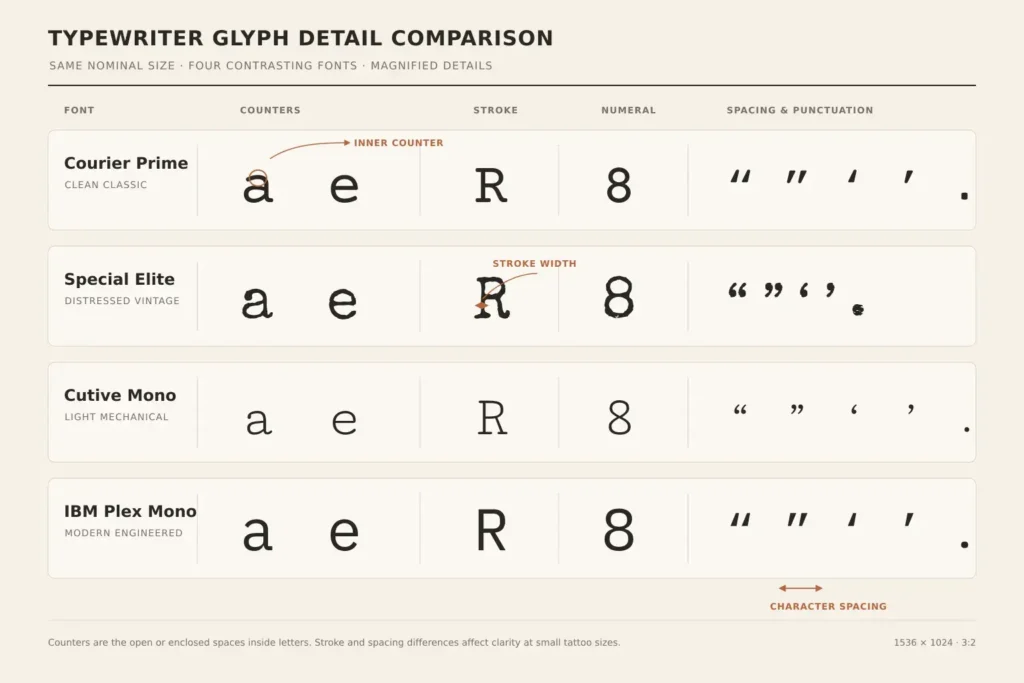
1. Stroke Weight
Very thin strokes can lose contrast, while extremely heavy strokes can close small counters and spaces. The appropriate weight depends on the font, size, placement, and the artist’s technique.
Look at the narrowest part of each letter—not only the boldest vertical strokes.
2. Letter Spacing
Monospaced fonts give each character the same amount of horizontal space, but that does not guarantee that every word will work unchanged on skin. Combinations such as rn, cl, mm, and punctuation placed close to a letter deserve special attention.
Your artist may increase the overall tracking or make optical adjustments while retaining a typewritten rhythm.
3. Counters and Small Details
Counters are the enclosed or partially enclosed spaces inside letters such as a, e, o, p, and R. If these spaces already look tight in the stencil, reducing the design further is unlikely to improve it.
4. Uppercase, Lowercase, and Numerals
All caps can feel direct and mechanical. Lowercase usually feels more personal but introduces ascenders, descenders, and smaller internal spaces. If the tattoo contains a date, coordinates, or a time, compare the numerals as carefully as the alphabet.
5. The Emotional Tone
Courier Prime feels familiar and literary. Special Elite feels weathered. American Typewriter feels warmer. IBM Plex Mono feels technical. Choose the voice that supports the meaning of the text rather than selecting a font only because it resembles an old machine.
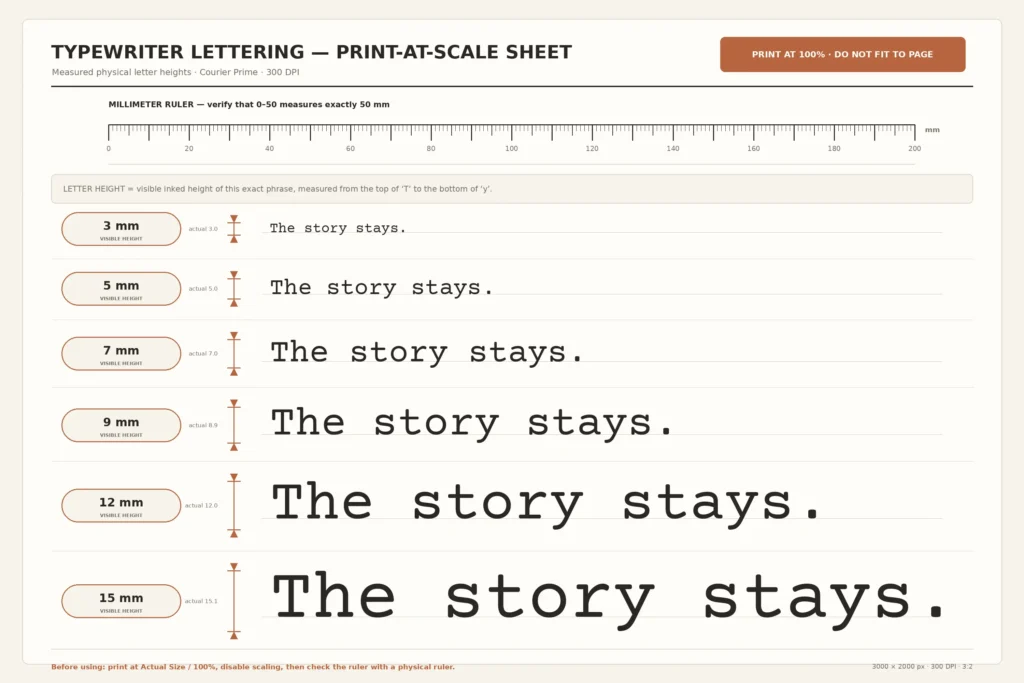
Tattoo Lettering Size: Use Physical Measurements, Not Point Size
A recommendation such as “6–12 pt” is not reliable for tattoo lettering. Point size describes a font’s digital or print em square; it does not tell you the exact height of the visible letters on skin. Two fonts set at the same point size can produce noticeably different shapes and dimensions.
Use this process instead:
- Set the exact, proofread text in two or three candidate fonts.
- Print each option at 100% scale.
- Measure the visible letter height and total line length in millimeters.
- Place the printout against the intended body area.
- Ask the tattoo artist to prepare a stencil at the proposed physical size.
- View the stencil with the body relaxed and moving naturally.
- Increase the size or spacing if any counter, serif, or punctuation mark looks crowded.
There is no universal minimum size that works for every font and placement. The artist should make the final recommendation after evaluating the design and skin in person.
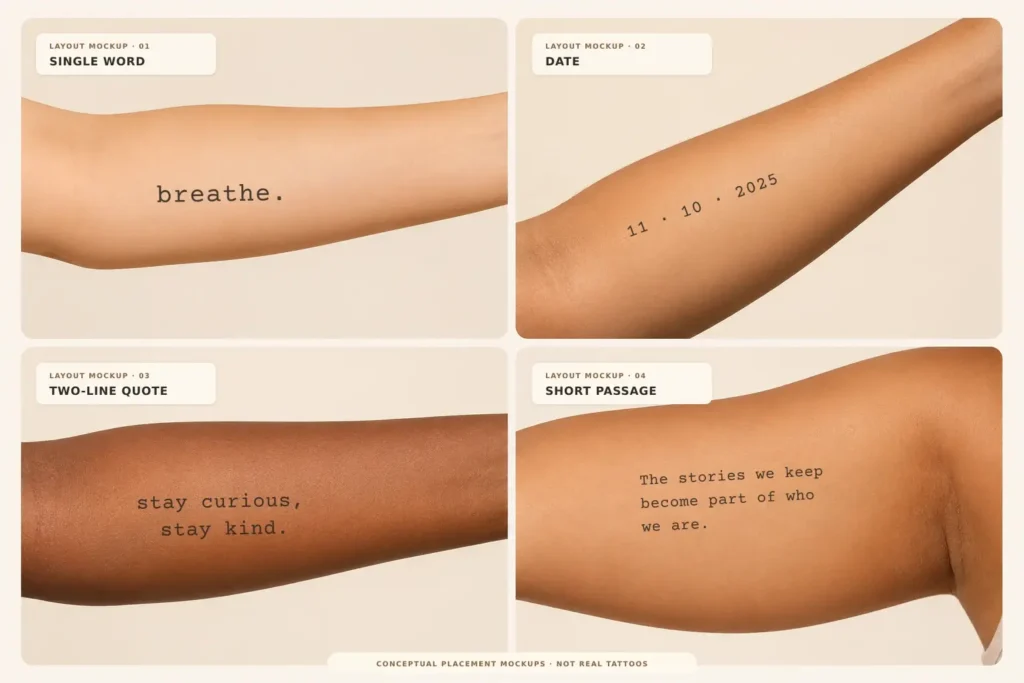
Layout Ideas for Words, Dates, and Quotes
A Single Word
A single word gives the artist room to refine every letter. Try lowercase for a personal tone, uppercase for a stronger mechanical feel, and a capitalized version for something in between.
A Name or Date
Names and dates usually benefit from one line, restrained punctuation, and generous space around the design. Check similar characters carefully: 0/O, 1/I/l, and 5/S can be confused in some typewriter faces.
A Short Quote
For a quote, test both one-line and two-line layouts. A line break should support the phrasing rather than divide two words that belong together. Compare centered alignment with a flush-left layout that resembles a typed page.
A Longer Passage
Long passages create more opportunities for tiny text, crowded lines, and transcription errors. Consider shortening the quote or choosing a placement that permits a larger layout. Proofread the final stencil character by character before tattooing begins.
Placement, Movement, and Longevity
No placement guarantees a perfectly crisp tattoo for life. Exposure to sunlight, friction, repeated movement, skin characteristics, body changes, ink, design decisions, technique, and aftercare can all influence how lettering changes.
When discussing placement with your artist, consider:
- Whether the complete text is visible when the body is relaxed.
- How the line bends or stretches when the nearby joint moves.
- How often the area experiences sunlight, washing, rubbing, or pressure.
- Whether the available space allows a comfortable letter height and line length.
- Whether existing tattoos will crowd the new lettering over time.
Flat-looking areas can still curve and move, so approve the stencil on the body—not only as a rectangle on a screen.
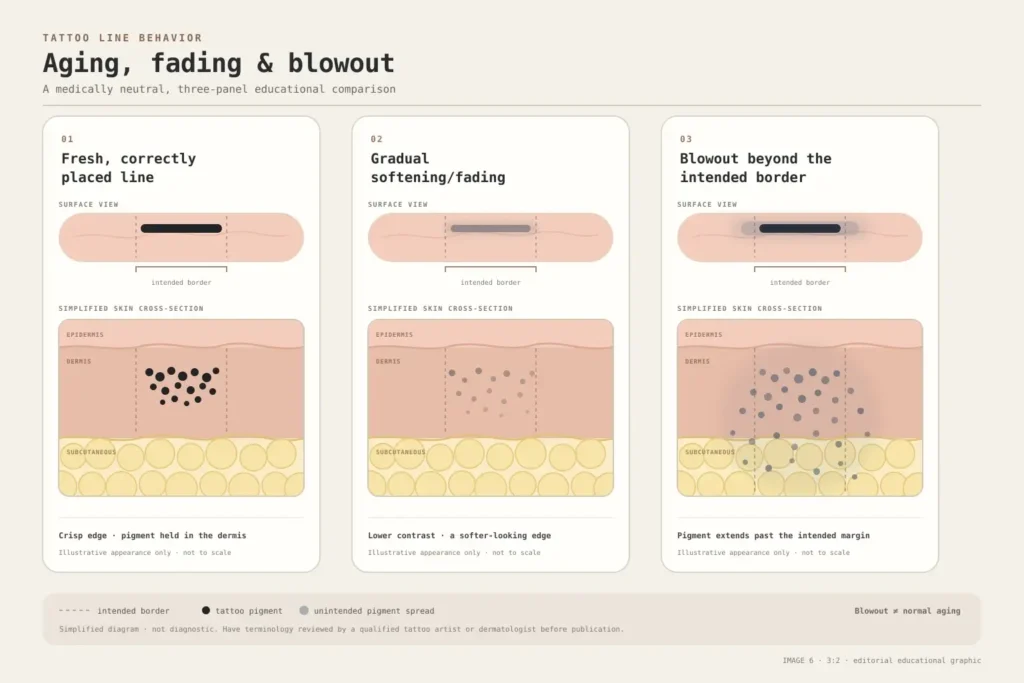
Aging, Fading, and Blowout Are Not the Same
These terms should not be used interchangeably.
Normal Softening and Fading
Tattoo lines can gradually lose some sharpness or contrast as the tattoo and skin change. The result varies widely. Clear spacing and a design that does not depend on microscopic details can give the lettering more room to change while remaining recognizable.
Tattoo Blowout
A tattoo blowout is an unwanted spread of pigment beyond the intended border of the design. It is considered an acute tattooing complication, not simply another name for normal aging. Published medical literature describes it as pigment spreading outside the original margins, sometimes producing a permanent blurry halo.
Choosing an experienced artist and an appropriate design is more useful than attempting to prevent blowout through font selection alone.
Sun Exposure and Long-Term Care
During healing, follow the instructions supplied by your tattoo artist or healthcare professional. Once the tattoo has healed, the American Academy of Dermatology recommends protecting tattooed skin from ultraviolet exposure with shade, protective clothing, and broad-spectrum, water-resistant SPF 30 or higher on exposed skin.
Common Typewriter Tattoo Mistakes
| Mistake | Why It Creates a Problem | Better Approach |
| Copying a digital font without adaptation | Screen details may not translate cleanly to skin | Let the artist redraw and simplify where needed |
| Choosing the smallest possible size | Counters and punctuation can become crowded | Compare larger stencils at physical scale |
| Reproducing every distressed texture | Tiny gaps and chips may become visual noise | Preserve the overall irregularity, not every pixel |
| Ignoring punctuation | A missing apostrophe or incorrect quotation mark is permanent | Proofread the final stencil character by character |
| Using a font generator as the final stencil | Generators cannot evaluate skin, placement, or technique | Use the generator only to create a shortlist |
| Approving the design only on a screen | A flat preview does not show body curvature | Inspect the stencil on the intended placement |
| Selecting an artist from fresh photos alone | Fresh work does not show how their lettering heals | Ask to see healed examples of comparable lettering |
Final Stencil Checklist
Before the session begins, confirm all of the following:
- The quote, name, date, and punctuation match the verified source.
- Every character is easy to distinguish.
- The font version shown in the stencil is the version you approved.
- The letter height and total line length have been checked physically.
- Counters and spaces remain open at stencil size.
- The layout follows the body when it is relaxed and moving.
- You have seen healed lettering work from the selected artist.
- You understand the artist’s aftercare instructions.
Turn the Text Into a Tattoo-Ready Conversation
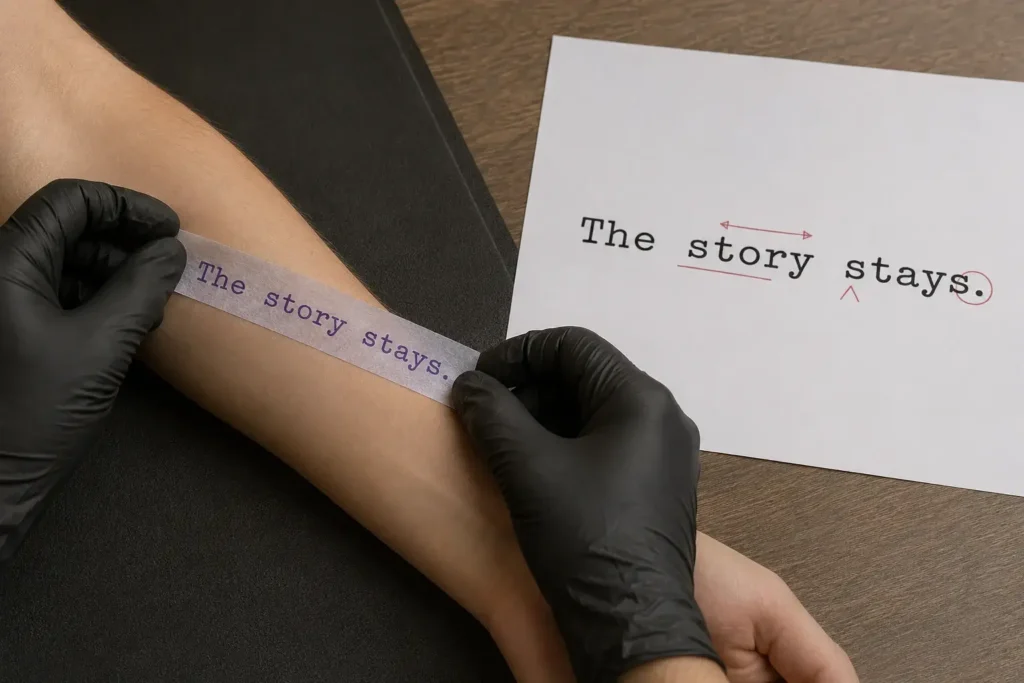
Choose two or three fonts that match the voice of your message. Print the exact text, verify every character, and take the samples to a tattoo artist with strong healed lettering work. The goal is not to copy a font perfectly—it is to translate its character into lettering that fits your body and can be executed responsibly.
Frequently Asked Questions
Are typewriter fonts good for tattoos?
They can be. Their structured shapes and restrained style make useful starting points for lettering, but the font must still be adapted to the text, size, placement, and artist’s technique.
What is the best typewriter font for a tattoo quote?
Courier Prime is a versatile clean starting point, while Special Elite creates a more visibly aged effect. The better choice is the one that matches the message and remains clear in the artist’s stencil.
How small can a typewriter tattoo be?
There is no reliable universal minimum. Judge the design by its measured physical dimensions, narrowest strokes, counters, spacing, placement, and the artist’s healed work—not by point size alone.
Can I use an online font generator?
Yes, but use it to compare styles and line breaks. A generator cannot determine whether a design is suitable for your skin or replace an artist’s redraw and stencil test.
Do typewriter tattoos age well?
They can remain readable when the design has sufficient structure and space, but outcomes vary. Technique, placement, sun exposure, healing, long-term care, and individual skin characteristics all matter.
Should I choose black ink or color?
High contrast can support readability, but no color choice guarantees a particular result. Discuss pigment, skin tone, placement, and healed examples with an experienced artist.